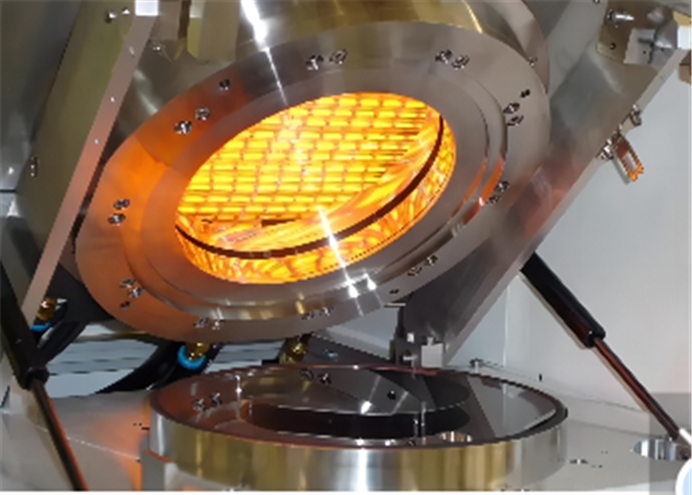
On the 300mm line, a 15-second soft bake that drifts by 2°C will show up as a linewidth excursion in the resist. You only get one shot at exposure. We built the fast-response infrared heater bulb to keep the thermal budget inside the window, cycle after cycle. What matters under the hood We run short-wave halogen elements inside quartz envelopes—chosen for fast radiant response and stable emissivity. Response time is under 200ms, and temperature control holds ±0.1°C across the wafer surface. The design lives in Class 1–100 cleanrooms with zero particle generation, and output stays repeatable over 5,000+ hours with less than 5% degradation. Why this works in photoresist processing Soft bake, hard bake, proximity baking—temperature uniformity is what drives CD uniformity and defect density. Fast response shrinks the stabilization window, so you cut idle time without giving up uniformity. The payoff is higher throughput, tighter process windows, and fewer scrap wafers. Energy use drops, too, because heat is delivered on demand, not stored. What you need to watch Installation tolerances are tight. The bulb has to align with the reflector geometry and the target distance—otherwise you get hot spots and uniformity drifts. Before changeover, verify the tool’s socket, voltage, and mounting hardware. We support standard interfaces, but legacy bake plates may need custom fixtures. Plan to inspect the reflector every 2,000 hours to keep performance where it should be.