

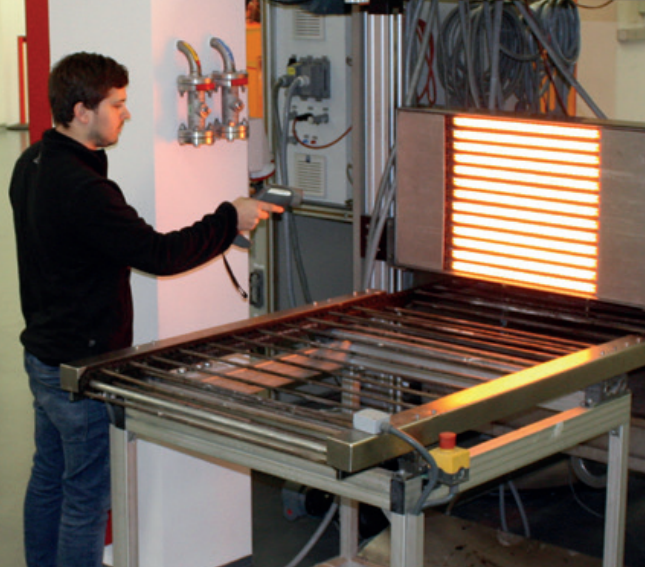
On the 300mm line, photoresist bake isn’t just another thermal step. It’s a dimensional promise. Let soft bake and hard bake drift even a hair outside ±0.1°C, and your critical dimension control falls apart. Conventional hotplates choke on edge-of-wafer repeatability, and convective ovens bring airborne contamination into the equation. In a Class 1–100 cleanroom, particle generation and unplanned downtime don’t cost minutes—they cost you entire lots. What matters under the hood We built the NIR wafer dryer around near-infrared radiation: direct, volumetric heating with zero airflow. The payoff is wafer-level uniformity at ±0.1°C across the full process window, and photoresist temperature that locks onto setpoint in seconds. No moving air means no particles. The chamber is static and fully enclosed, so the only thing touching the wafer is the wafer itself. The system is engineered for 24/7 fab duty—components rated for continuous operation, and a thermal architecture that holds repeatability through thousands of cycles. Cleanroom compatibility is baked into the design, not tacked on. It’s mechanically sealed, chemically compatible, and validated to keep particle counts at background levels. Why this plays in lithography In lithography, bake uniformity is the lever that moves CD stability and yield. The NIR dryer slashes thermal ramp time, trims thermal budget, and wipes out the variability that comes from oven stratification or hotplate edge losses. You end up with tighter distributions on soft bake and hard bake, fewer reworks, and more predictable line performance. Energy use drops because the energy goes straight into the wafer, not into heating air or massive fixtures. Maintenance intervals stretch out since there are fewer wear-prone moving parts. And process windows widen because temperature repeatability stops being the bottleneck. What you need to plan for NIR needs direct line-of-sight to the wafer surface, so the tool layout has to keep that optical path clear inside the chamber. When integrating into existing tracks, pay attention up front to mechanical envelope and communication protocols—we provide the interface specs early so you don’t get bitten during field integration. At initial qualification, expect a short thermal soak to dial in recipe parameters for your photoresist stack. Once you set it, the process settles in—repeatable, quiet, and consistent. Day after day. Lot after lot.